H-Park.
A free, open-data map of accessible parking spaces. The app I needed before I could build it.
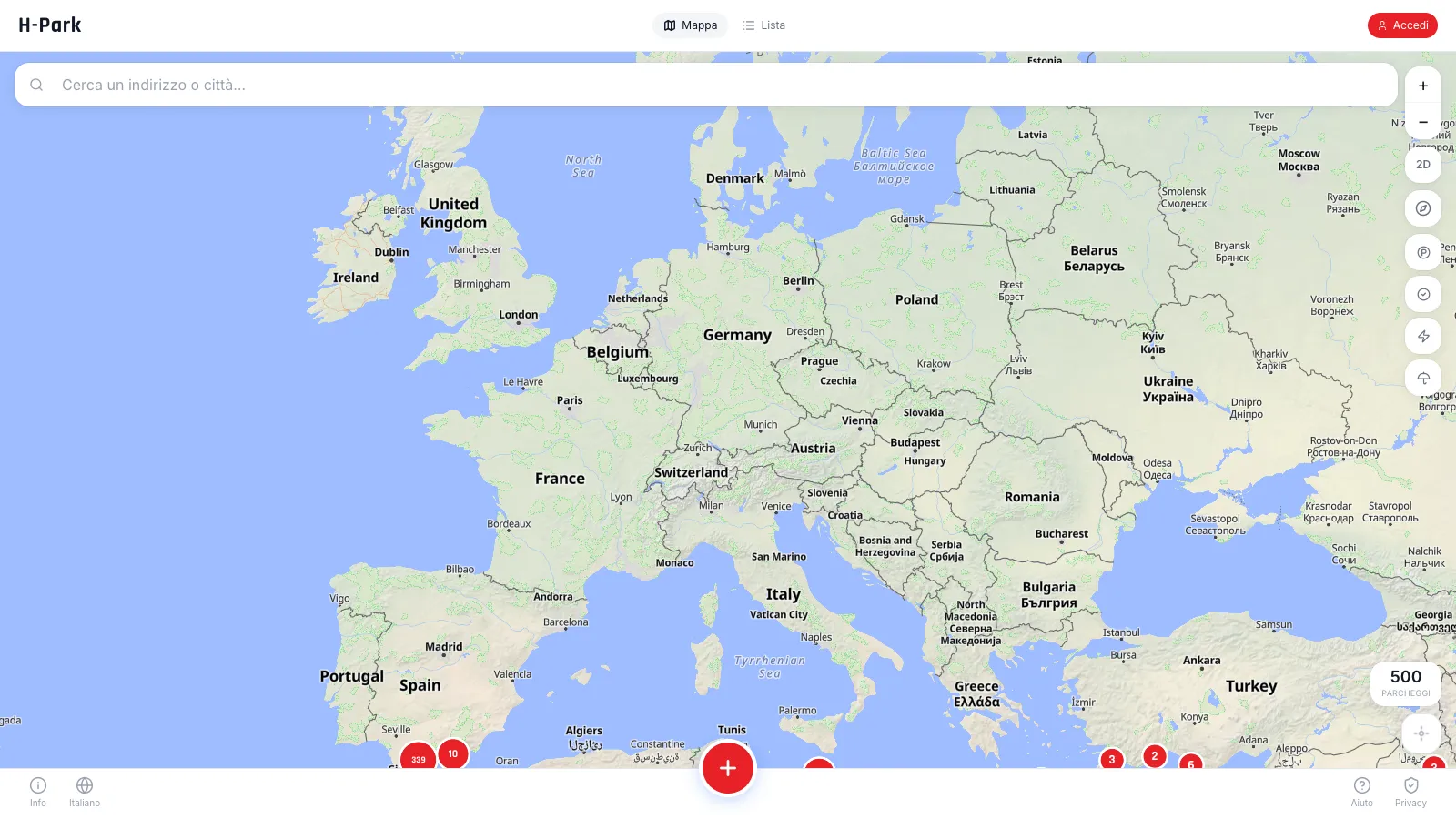
- Client
- Personal project on Poletto 1976
- Sector
- Civic tech · Accessibility
- Period
- March 2026 – present
- Role
- Promoter and Full-stack developer
- Stack
- React 18, Vite 7, MapLibre GL JS, Supabase, i18next, DeepL API, Resend, vite-plugin-pwa
- Website
- h-park.online
A note on the current version: H-Park is an active project, released as a progressive web app to validate the idea with real users. To do that it relies on free map services, so you may notice some lag or imprecision in the maps. These will be addressed when H-Park becomes a native app.
The challenge
I am disabled. Not in a wheelchair, but I can't walk long distances. On bad days, the difference between finding accessible parking close to my destination and parking two blocks away is the difference between making it inside or turning back home. For years I did what most people do: I drove around, hoped, and guessed.
When we finally evaluated the idea seriously at Poletto 1976, we looked at what already existed. There were apps covering accessible parking, with decent data and reasonable interfaces, but almost all of them made you pay to see the information. A person with a disability had to subscribe to a service just to know where they were legally allowed to park.
That felt wrong. Accessibility data shouldn't be a product: it should be a public good. That is what gave H-Park its reason to exist.
The other half of the problem was the data itself. Official open data on accessible parking is scattered across portals and formats, often stale and with unclear licences. I wrote about it in Open data is not open enough.
The approach
H-Park is built during the 10% of our time that Poletto 1976 gives to projects we believe in rather than projects we are paid for. I am the only developer; the rest of the team, product consultants, contribute ideas, feedback and strong opinions about UX.
- Open data, verified by people. Parking data comes from OpenStreetMap, and anyone can add, edit or remove a parking space. Community ratings and a verification system, enforced with Supabase Row Level Security, keep the data trustworthy.
- No account needed to look. The map is free and open: you sign in (magic link or Google) only to contribute.
- Filters that matter. Elevator access, covered spaces, EV charging, maximum stay, parking type (underground, multi-storey, street) and free or paid.
- From the map to the car. One tap hands the destination over to Google Maps, Apple Maps, HERE WeGo, Tesla or Mercedes-Benz navigation.
- An app without a store. An installable PWA built with React, Vite and MapLibre GL, with a 2D/3D map, real-time geolocation and offline support on iOS and Android.
- Every language at once. Spanish, English, Italian and French with automatic detection, and Edge Functions that translate user reviews on demand through the DeepL API.
The outcome
As of October 2026, H-Park maps 418,136 parking locations with 197,604 accessible spaces across 49 countries, and the numbers keep growing as the community adds spaces.
With version 2.0 H-Park opened a public API: any developer can request a key from their profile and build their own tools on the same data. The data stays open, and the infrastructure stays maintained.
The app is free. Every pin on the map is someone's day made a little easier.